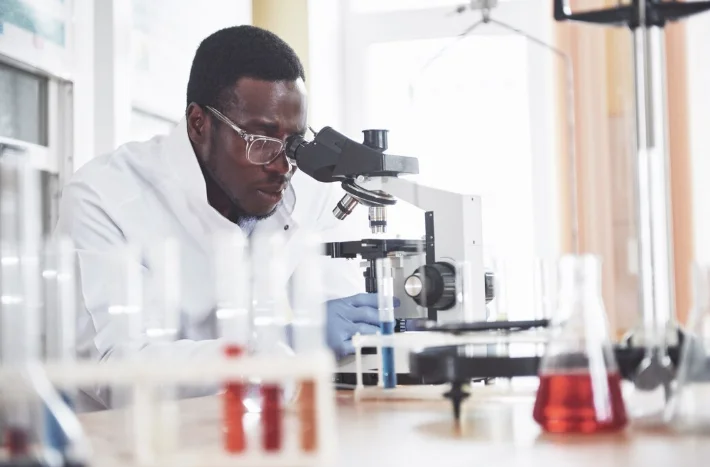
Bachelor of Medical Laboratory
Overview
Job Growth
N/A
Duration
N/A
Avg. Salary
N/A
Career Paths
N/A
Program Description
The Bachelor of Medical Laboratory is a hands-on degree that trains you to work in clinical laboratories and support patient care. You will study anatomy, physiology, microbiology, clinical biochemistry, haematology, immunology, parasitology, laboratory safety, and quality assurance. The program teaches sample collection, laboratory testing, result interpretation, and data reporting. Graduates can work as medical laboratory scientists, medical laboratory technicians, public health officers, or progress to specialised roles in molecular diagnostics, hospital laboratories, blood banks, and research. This program prepares you to join Ghanaian healthcare teams, improve disease detection and prevention, and build a stable, in-demand career in health and medical sciences.
Aims & Objectives
Develop accurate sample collection and handling skills, demonstrated by proper venipuncture and specimen labelling in clinical settings.
Master core laboratory techniques in microbiology, haematology, and clinical chemistry, measured by competency assessments and practical exams.
Understand laboratory quality assurance and infection control procedures, shown by ability to follow protocols and document quality control results.
Apply health data management and reporting skills using laboratory records and basic electronic systems, evidenced by accurate test result entry and report generation.
Why Choose This Program?
Strong job demand
Medical laboratory professionals are needed in hospitals, clinics, blood banks, and public health, offering steady employment in Ghana and beyond.
Practical, hands-on training
The program includes extensive laboratory practicals and hospital attachments that build real-world skills employers value.
Pathways to specialisation
Graduates can specialise in molecular diagnostics, immunology, or laboratory management, or pursue postgraduate study.
Impact on community health
Work directly contributes to disease diagnosis, outbreak response, and public health, making the role rewarding and socially important.
Skills & Tools
Skills You'll Develop
Venipuncture, urine and swab collection, proper labelling, centrifugation, aliquoting, and specimen preservation for accurate testing.
Operation and basic maintenance of microscopes, centrifuges, spectrophotometers, and haematology analyzers for diagnostic tests.
Performing and interpreting tests in microbiology, biochemistry, haematology, and immunology to support clinical decisions.
Implementing quality assurance protocols, control charts, and strict biosafety practices to ensure reliable, safe results.
Recording and managing laboratory results, basic use of Laboratory Information Systems and spreadsheet analysis for reporting.
Tools & Resources
Laboratory Information System (LIS)
Microsoft Excel
Challenges & Tips
Challenges
Heavy science workload and practical hours
Mastering precise laboratory techniques
Tips & Advice
Create a study schedule, form lab study groups, and practice techniques regularly during supervised sessions.
Seek extra practical sessions, ask instructors for feedback, and rehearse steps until confident.
Video Guide
Frequently Asked Questions
Ready to Apply?
Find programs that match your grades and interests - even if you haven't written WASSCE yet
Loading.. Please wait.

Talk to a Professional
Join a mentorship session with real professionals working in your field of interest.
 Real industry professionals
 Small groups (10-15 students)
 Starting at GH₵ 15 per session