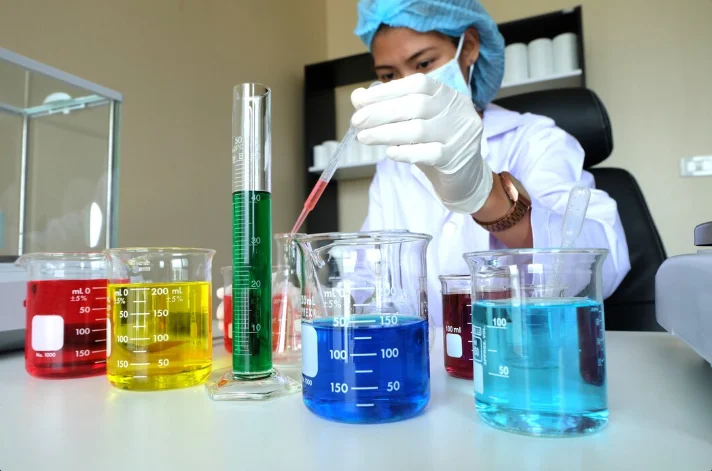
Chemistry
Overview
Job Growth
N/A
Duration
N/A
Avg. Salary
N/A
Career Paths
N/A
Program Description
Chemistry is the scientific study of matter, its properties, and how substances interact and change. In this program you will learn core topics such as atomic structure, chemical bonding, stoichiometry, acids and bases, organic chemistry, analytical methods, and laboratory safety. Practical lab work, experiments, and simple research projects help you apply the scientific method and develop careful data skills. Studying Chemistry opens careers as a research scientist, laboratory technician, environmental scientist, quality control analyst, or science teacher — roles needed in Ghana’s healthcare, industry, agriculture, education and environmental sectors. If you enjoy hands-on experiments, problem solving, and discovering how the world is built at a molecular level, this program will prepare and inspire you for further study or work in science.
Aims & Objectives
Develop safe laboratory techniques and follow standard safety protocols when handling chemicals and equipment.
Master core chemical concepts (stoichiometry, bonding, thermochemistry, organic reactions) to solve exam and real-world problems.
Understand and apply the scientific method by designing, conducting, and reporting at least three small experiments or investigations.
Apply basic data collection and statistical analysis skills to interpret experimental results using charts, averages, and error estimation.
Create clear scientific reports and laboratory records that document procedures, results, and conclusions to recognised standards.
Why Choose This Program?
Strong career prospects
Chemistry graduates are needed in health, industry, agriculture and environmental sectors across Ghana and beyond.
Hands‑on practical learning
Regular laboratory work builds real skills in experimentation, instrumentation and safety that employers value.
Gateway to many fields
Chemistry provides a solid foundation for careers in research, pharmaceuticals, teaching, environmental science and quality control.
Industry and internship links
Students can access internships and lab attachments with universities, hospitals, testing centres and local industries.
Problem solving & innovation
Training encourages analytical thinking and creativity needed for solving community challenges and developing new products.
Skills & Tools
Skills You'll Develop
Practical skills in titration, filtration, chromatography, safe reagent handling and proper waste disposal.
Designing experiments, recording observations, calculating averages, uncertainties and using basic statistics to interpret results.
Preparing lab reports, research summaries and standard operating procedures that follow scientific conventions.
Formulating hypotheses, planning experiments, controlling variables and evaluating evidence to draw conclusions.
Basic operation and upkeep of lab instruments (balances, pH meters, spectrophotometers) to ensure accurate measurements.
Tools & Resources
Microsoft Excel
SPSS
R Programming
Laboratory Information Management Systems (LIMS)
Challenges & Tips
Challenges
Limited access to well‑equipped labs in some schools.
Difficulty linking theory to practical experiments.
Tips & Advice
Join shared lab sessions at nearby schools or universities, use school demonstrations, and practise virtual labs online.
Relate each theory topic to a specific lab activity, keep a lab notebook, and ask teachers for guided practical exercises.
Video Guide
Frequently Asked Questions
Ready to Apply?
Find programs that match your grades and interests - even if you haven't written WASSCE yet
Loading.. Please wait.

Talk to a Professional
Join a mentorship session with real professionals working in your field of interest.
 Real industry professionals
 Small groups (10-15 students)
 Starting at GH₵ 15 per session